Tune-ups
A tune-up that measures the system instead of just wiping it down
Preventative maintenance for air conditioners, air handlers, furnaces and heat pumps across Cypress, Houston and Spring, done to a published checklist.
Chapter 01
The slow failures that wait for the hottest week
Most Houston air conditioners do not die quietly in March. They get through spring on a condenser coil packed with cottonwood and lawn clippings, a condensate drain that is slowly silting up, and a capacitor that is a little weaker every month, then they quit on the first afternoon above 98 degrees. By that point the compressor has been drawing too many amps for a whole season, and the part that was going to cost a few dollars has taken a much more expensive part with it.
The furnace has its own version of the same story. It sits unused for most of the year, collects dust on the burner and ignition assemblies, and gets asked to start on the coldest morning with a flue and vent pipe nobody has looked at since it was installed. A cracked heat exchanger or a poor flue draft is not something you can smell or see from the living room, which is why carbon monoxide testing is the first line on the furnace sheet.
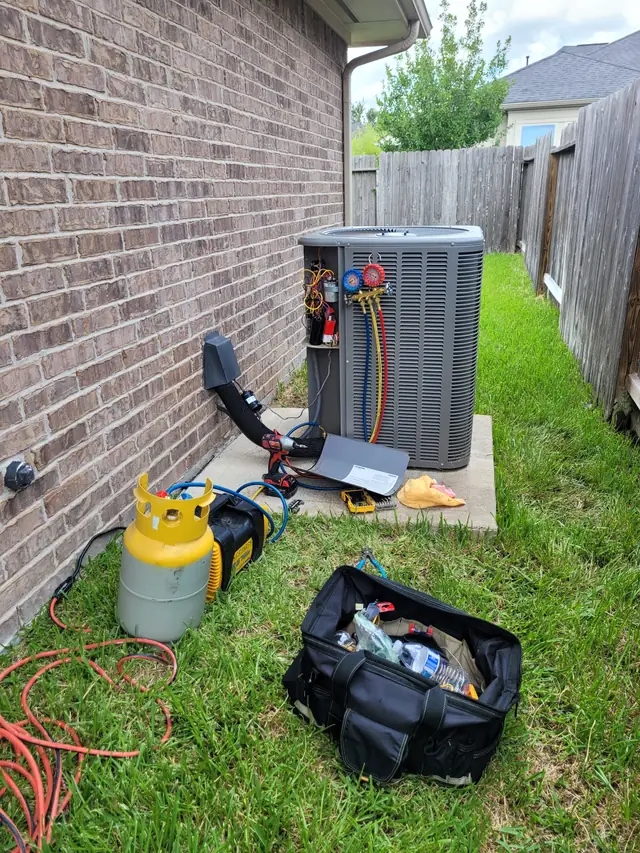
Condenser with its service panel off, manifold gauges connected and a recovery tank and tool bag beside it
What a visit from Cool-It actually covers
Cool-It publishes its tune-up sheets, and the list is long on measurements. On an air conditioner that means cleaning the condenser coil and the condensate drain, inspecting the evaporator coil if it is accessible, testing the condensate pump, tightening electrical connections and testing starting capabilities, then taking the numbers: air temperature differential, refrigerant pressure, amperage and voltage. The photo above shows the kind of setup that goes with it, panel off, manifold gauges connected, recovery tank within reach.
A furnace gets carbon monoxide testing, a clean burner assembly and ignition assembly, a check of flue draft and combustion, and an inspection of vent piping. A heat pump adds defrost controls and auxiliary heaters, and an air handler adds the evaporator coil, the safety controls and any electrical heating elements. Every sheet includes the filtration system, the blower motor and blower components, because airflow is where most comfort complaints start. The full lists are reproduced below, word for word.
Chapter 03
How often, and how to tell you are overdue
In Houston the sensible rhythm is once a year for cooling and once a year for heating, with the cooling visit ahead of the summer heat and the furnace visit before the first cold front. Cool-It lists the benefits plainly: a more comfortable indoor environment, reduced utility bills, a protected investment, fewer repairs and longer-lasting equipment. Service agreements are also offered to reduce breakdowns, so ask about them when you call (832) 316-2665.
Between visits, the signs that a tune-up is overdue are easy to recognise. Rooms that take longer to cool than they did last year, ice on the copper line, water around the air handler or in the drip pan, a breaker that trips when the system starts, a burning smell at the first furnace run of the season, or a bill that has crept up with no change in how you live. Any one of them is worth a call before it turns into an emergency repair, and a tune-up is the cheapest time to learn about it.
“He did a great job, serviced both of my AC units and even tidied up the wiring on the outside.” Lonny Larsen, Google review.
The tune-up sheets
Four checklists, exactly as Cool-It publishes them
Air Conditioner Tune-Up
- Clean condenser coil
- Inspect evaporator coil if accessible
- Clean condensate drain
- Clean blower motor
- Inspect filtration system
- Adjust blower components
- Inspect for refrigerant leaks
- Test condensate pump
- Tighten electrical connections
- Test starting capabilities
- Measure air temperature differential
- Monitor refrigerant pressure
- Measure amperage and voltage
Air Handler Tune-Up
- Inspect evaporator coil
- Clean blower motor
- Inspect filtration system
- Adjust blower components
- Test and adjust safety controls
- Tighten electrical connections
- Inspect humidification system
- Inspect electrical heating elements
Furnace Tune-Up
- Test for carbon monoxide leaks
- Clean burner assembly
- Clean ignition assembly
- Clean blower motor
- Inspect filtration system
- Adjust blower components
- Test and adjust safety controls
- Tighten electrical connections
- Check flue draft
- Check combustion
- Inspect vent piping
- Inspect humidification system
Heat Pump Tune-Up
- Clean condenser coil
- Clean condensate drain
- Check defrost controls
- Inspect auxiliary heaters
- Inspect filtration system
- Inspect for refrigerant leaks
- Test condensate pump
- Tighten electrical connections
- Test starting capabilities
- Measure air temperature differential
- Monitor refrigerant pressure
- Measure amperage and voltage
Tuning up an old system and wondering whether it is worth another season? Read about replacement and new installs, or send us a message to book a visit.