Repair
Air conditioner repair
The outdoor unit hums, the air from the vents is warm, and the house is climbing. Here is how a no-cool call gets diagnosed in Houston, Spring and Cypress.
Chapter 01
A condenser that hums and a house that won't cool
Most Houston air conditioners don't fail all at once, they get tired. A run capacitor weakens through a long August, the condenser fan starts a little slower each afternoon, and one day the outdoor unit hums, the indoor blower keeps pushing out warm air, and the thermostat sits three degrees above where you set it. In Houston heat the same few faults account for most no-cool calls: a worn capacitor or contactor, a fan motor dragging on tired bearings, or a refrigerant charge that has slipped because of a slow leak at a flare joint or a coil.
Heat and dirt make every one of those worse. A condenser coil packed with cottonwood fluff and lawn clippings can't shed heat, so head pressure climbs and the compressor works harder on every cycle. A clogged condensate drain can trip the float switch and shut the whole system off, which looks exactly like a dead air conditioner and is really a line full of algae. That's why "it won't cool" is only a symptom. The small causes and the expensive ones look identical from the thermostat, and the only way to tell them apart is to measure.
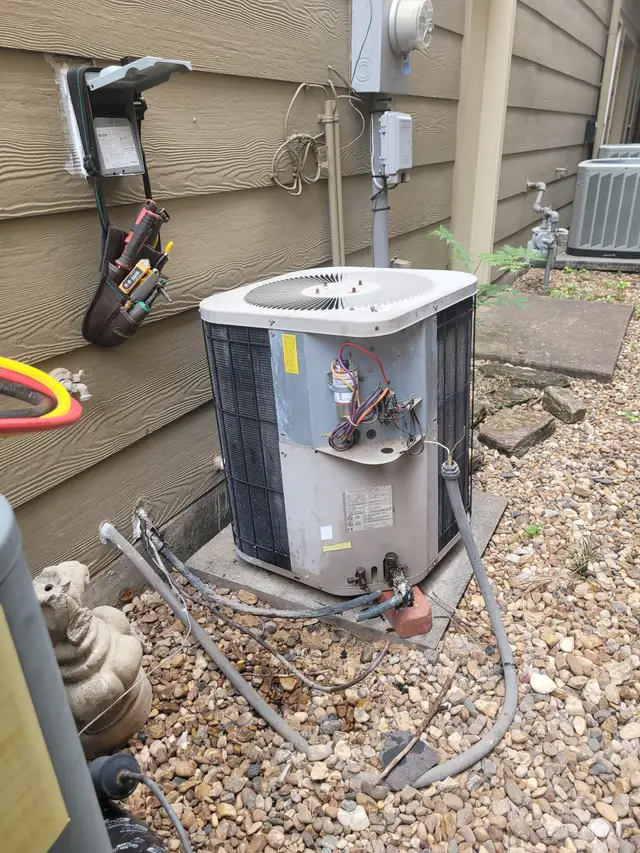
Condenser access panel off, capacitor and contactor wiring exposed, with a tool pouch and meter beside the unit
What gets measured before a part gets ordered
Cool-It's published tune-up list reads like a diagnostic procedure, and a repair call leans on the same checks: tighten electrical connections, test starting capabilities, measure amperage and voltage, measure the air temperature differential, monitor refrigerant pressure, and inspect for refrigerant leaks. A loose lug at the contactor can imitate a failed component and burn a terminal black if nobody catches it, so the connections come first. Then the unit is asked to start, and the run capacitor is read against the value printed on its own label instead of being judged by the sound it makes.
Gauges come next. Manifold gauges on the service ports give refrigerant pressure, the temperature split across the evaporator shows whether the system is really moving heat out of the house, and a leak inspection decides whether adding refrigerant is a repair or only a delay. The photo above is that moment on the job: access panel off, capacitor and contactor wiring exposed, a tool pouch and a meter waiting beside the unit.
When the fault turns out to be a part, the part gets replaced and the system is run again with the meter still connected. One Google reviewer, genn powell, described a same-day call where Vixiene tried a lower-level fix first, moved to the next level when that didn't hold, then picked up a part and worked into Friday evening until the problem was resolved. Another, Gary Walker, called Cool-It for a second opinion after a different provider listed several replacements on a relatively new system. He wrote that Vixiene spent longer on the system than the two other companies he called, and that none of the recommended work was needed.
Chapter 03
Staying out of the next breakdown
A repair fixes the fault in front of you. It doesn't change the heat load, the dust or the age of every other part in the cabinet. If a capacitor failed, the contactor and fan motor beside it have worked just as many summers, so ask for readings on those at the same visit, and ask what the amperage was, so next year's number has something to be compared against. Cool-It also offers service agreements designed to reduce breakdowns, which is the same idea put on a schedule.
Know the signs that a system needs another look: a breaker that trips when the outdoor unit starts, ice on the larger refrigerant line, a unit that runs all afternoon without closing the gap to the setpoint, or a hum with no fan movement. Don't keep resetting a tripped breaker, because it is telling you something is drawing too much current. Furnace and heat pump faults are handled on their own heating page, since the parts and the safety checks are different.
For urgent repairs or emergency service, call (832) 316-2665. The shop sits at 12915 Cypress North Houston Rd in Cypress, the family-owned business has served Houston, Spring and Cypress since 2009, and the work is done under Texas air conditioning contractor licence TACLB 28315E.
"Vixiene did an exceptional job on my AC repair." Tiffany Schultheis, Google review
The readings behind a diagnosis
Six checks from the tune-up sheet that also decide a repair
Air Conditioner Repair, Heating Repair and Emergency Assistance all go through the same number, (832) 316-2665.
- 01Tighten electrical connectionsRules out a loose lug before anyone blames the contactor.
- 02Test starting capabilitiesShows whether the compressor and fan start cleanly or strain.
- 03Measure amperage and voltageA rising amp draw names a tiring motor before it locks out.
- 04Measure air temperature differentialProves the coil is moving heat, not only moving air.
- 05Monitor refrigerant pressureReads the charge against what the unit should be holding.
- 06Inspect for refrigerant leaksDecides if a top-up is a fix or a delay.
Heat is a different job with different safety checks, so furnaces and heat pumps have their own page: heating repair and furnace work. If you would rather write than call, send a message and the shop will come back to you.